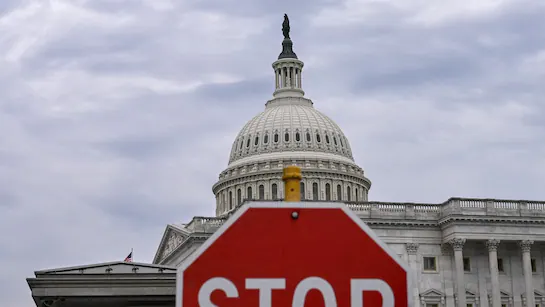
What is a government shutdown?
It’s when government agencies across the nation are temporarily closed and staff are furloughed due to a lapse in federal funding. It means that some, but not all, US government services are temporarily suspended, and 40% of the federal workforce – about 750,000 people – are expected to be put on unpaid leave.
What is the Process to avoid shutdown?
Congress must pass an appropriations bill for funding to be allocated, but this process is being held up in the Senate. While Republicans currently hold the majority in the House of Representatives and the Senate, they can’t pass the bill on their own. Because they need 60 votes in the Senate to advance the bill to a vote. They are currently seven seats short. Hence without the help of Democrats they can’t able to pass the bill.
What Democrats Wants?
Democrats want an extension for tax credits that make healthcare more affordable, including extending Obamacare subsidies and reversing cuts to Medicaid and other programs added to the budget, but Republicans aren’t willing to make the compromise.
What Republicans Wants?
Republicans want Democrats to agree to a temporary funding plan, called a continuing resolution. This would reopen the government for now while talks continue on a longer-term budget. Democrats, however, say they are tired of short-term fixes. They want their main demands addressed immediately—making sure subsidies for low-income health insurance don’t end and reversing the Trump administration’s cuts to Medicaid.
How long did previous shutdowns last?
Most shutdowns are relatively short affairs. Half have lasted just three days or less, and mostly extended over a weekend, when the impact of reduced government operations is minimal.
But there’s no guarantee the current shutdown will be over that fast. The longest shutdown in history, which was also the most recent, occurred under Donald Trump for 35 days from 2018 to 2019.
How are shutdowns resolved?
The short answer is through negotiation. That can be through the party in power agreeing to the opposition’s demand, the opposition conceding, or by both parties agreeing to temporarily extend government funding while they continue talks.
How do shutdowns effect the economy?
Shutdowns usually don’t leave huge marks on the US economy. But the impact will be felt by the federal workforce. While many are required to continue working, they won’t be paid for their time until after the shutdown ends. But if Trump ends up firing workers, rather than temporarily putting them on furlough, the impact could be more substantial.
Conclusion
The shutdown is essentially driven by vote bank politics. Both parties seek to sway public sentiment. While Democrats believe their party’s healthcare initiatives are popular with the public, Republicans argue that the shutdown was forced upon them by Democrats and want to portray them as the villains in this scenario.
Also, refer to the following: